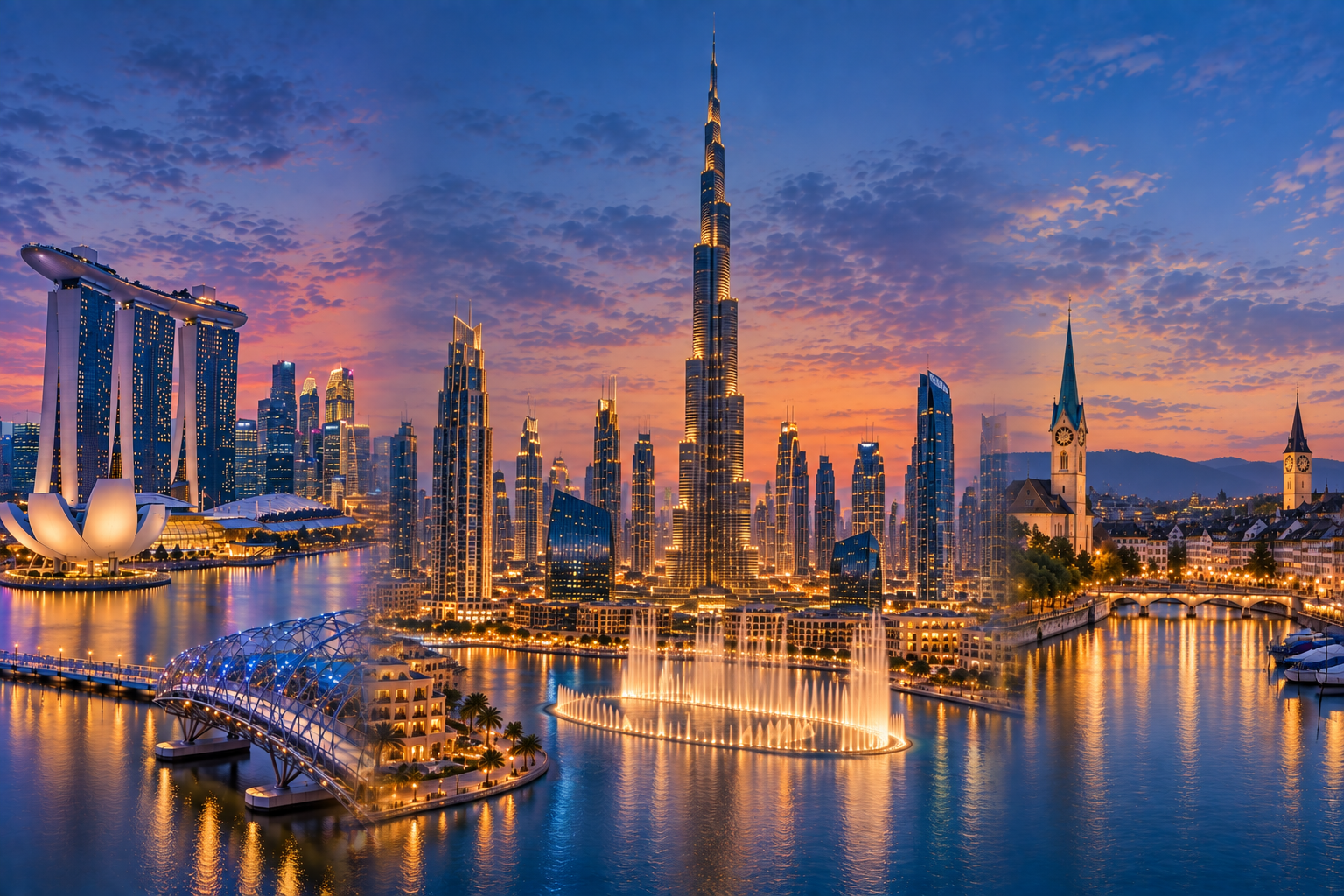
Volatility rarely makes capital disappear. More often it makes investors pickier, and they move towards places where the rules are least likely to change suddenly.
Singapore and Switzerland are the usual examples. Singapore came through the Asian financial crisis of 1997-98 bruised but still trusted as a place to hold money and run a business. Switzerland kept its institutions intact through two world wars. The UAE is now being tested far more directly. Since late February it has been hit repeatedly by Iranian missiles and drones as part of a regional war that is still unresolved. It is too early to say how that test ends, but it is a fair moment to look at what each of these countries built and why it matters.
I have operated in the UAE for many years, and this year has not been easy for anyone here. But what I have noticed is that the systems that matter for business kept working. Day-to-day business carried on – banks stayed open, payments went through and contracts were honoured. For me, that says a lot about what the country has built, and it is why I remain optimistic about the long term.
What stability is made of
It is easy to call a country stable. I think it is more useful to ask what that stability is built on.
In Singapore, a big part of the answer is the Monetary Authority of Singapore. Most central banks manage the economy by changing interest rates. MAS manages the Singapore dollar against a group of currencies from its main trading partners, and allows it to move within a range that it does not publish. The reason is simple: Singapore’s trade is worth more than three times its GDP, so the exchange rate affects inflation much more than interest rates do. This kind of predictability makes long-term investors feel safe.
Switzerland’s stability comes from its neutrality, a currency that investors see as a safe haven and laws that change slowly. Companies there expect the rules in ten years to look much like the rules today, and they trust the courts to protect their contracts and property. Strong banking supervision and low corruption add to the feeling that money in Switzerland is protected from sudden policy changes.
The UAE has built its own version, and in some ways it has done it faster. The dirham has been linked to the US dollar for decades, so most businesses do not need to worry about currency risk. Two financial free zones, DIFC in Dubai and ADGM in Abu Dhabi, have courts based on English common law. There is no personal income tax, and since 2021 foreign investors can fully own most onshore companies. Not everything has stood still – a 9% federal corporate tax arrived in 2023 – but it was announced well ahead of time, and for investors that kind of notice matters as much as the rate itself. On top of this, years of investment in ports, airports and logistics have made the UAE a natural hub for the region.
From my own experience, the difference is felt in daily business. Setting up a company, opening a bank account or getting a visa for staff is quick and straightforward here. That speed comes from deliberate policy.
What the numbers say
The latest data is strong. In 2025 the UAE attracted around 48 billion US dollars of foreign direct investment, the ninth highest in the world and the highest in the Middle East. It was the fourth record year in a row, and the UAE was second in the world for new greenfield projects.
These numbers are from before the war, and UNCTAD expects the conflict to hit investment in 2026. But the country is not waiting. The government has set up a 10 billion US dollar National Investment Fund, and the Central Bank and Dubai have launched support packages for banks and businesses.
The Central Bank has lowered its 2026 growth forecast from 5.6% to 1.7% because of the war. It expects growth to jump to 9.8% in 2027, depending on when shipping through the Strait of Hormuz returns to normal. In other words, it sees this as a temporary shock to an economy that is still sound underneath.
For me, that is the most important point. When conditions are good, every country looks strong. The real question is whether people still trust a country when conditions get worse. Singapore and Switzerland have both had bad years, most recently Singapore’s recession in 2020 and the collapse of Credit Suisse in 2023. Their reputations come from how they recovered.
Looking ten years ahead
If the UAE keeps its institutions steady through this period, and I believe it can, I would not be surprised to see it follow the path of Singapore and Switzerland. Dubai is already a major financial and logistics centre. The next step is to join the very top tier, where a country’s reliability is simply assumed. That would happen slowly, through thousands of business decisions where nobody questions it any more.
The companies that set up in Singapore in the 1970s and 80s had no guaranteed outcome. They trusted a system that was still proving itself. The UAE is in a similar position today, under much more pressure than anyone expected at the start of the year. My advice to anyone thinking about a long-term commitment to the region is to look past the headline growth numbers. Watch how the courts, the regulators and the currency system perform while the region is under stress. So far, as someone who has done business here for many years, I can say they have held up well.